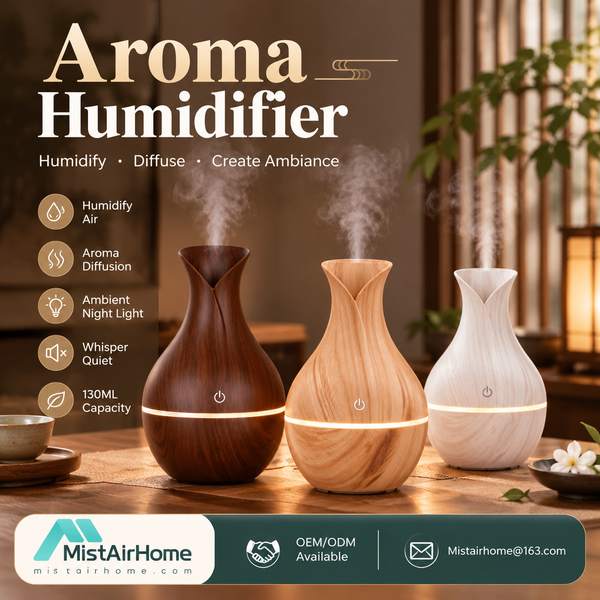
 Quality Aroma Humidifier — Wholesale from MistAirHome China Factory. Custom Branding Available.
Customer Service Hotline:
+8613261677119
Quality Aroma Humidifier — Wholesale from MistAirHome China Factory. Custom Branding Available.+8613261677119
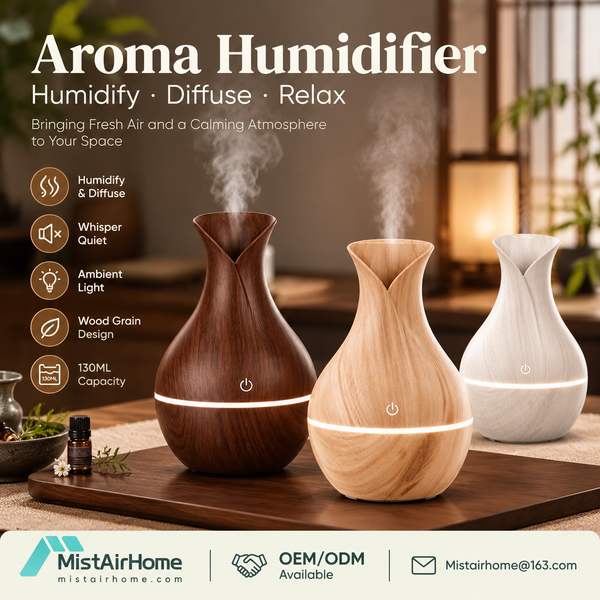
TL;DR - The Mistairhome WL-AH01B (PLUS) holds 305 mL and mists 40 mL per hour or 18.5 mL per hour, which is 7.6 hours and 16.5 hours per fill; the oil side takes 3.1 mL and runs 12.9 hours per fill at 0.24 mL per hour; it covers 14 sq m (154 sq ft) at a 2.6 m ceiling and measures 23.4 dB on the high step and 20.6 dB on the sleep step; it draws 2.8 W and takes its supply from USB-C 5V/1A, runs from a laptop port or a phone charger; separate oil tray above the water line, so the oil never reaches the disc or the tank; the humidistat holds target band 30 to 75 percent in 5 percent steps, held within 3 percent over Wi-Fi 2.4 GHz with Bluetooth fallback for first pairing, and iOS 14 or later and Android 9 or later, scent and mist scheduled separately, voice runs through Amazon Alexa and Google Home for on off, mist step and scent step; no internal cell on this build; it weighs 413 g and measures 12.6 x 12.6 x 18.4 cm, and ships documented to CE / RoHS / FCC standards for import into Colombia. MOQ is 200 units per SKU with a 25-35-day lead time, FOB Shenzhen or EXW Longgang.
China Wanlin supplies the Quiet Aroma Humidifier with Sleep Mode category as a direct manufacturer, not as a trading intermediary. The unit described below is one configuration out of 24 combinations (8 chassis x 3 SKU builds) that share a common misting family, a common oil path and a common documentation set, so a distributor can build a coherent shelf from one source rather than stitching together unrelated suppliers. Every unit referenced on this page corresponds to a specific bill of materials held on file, so the figures below can be reproduced or independently verified at sample stage.
The scent path is the part that separates this range from a humidifier with a few drops poured into the tank. The oil sits in its own tray or pad above the water line, on seals rated for citrus and resin blends, so the disc, the tank and the gasket never contact the oil. That is what keeps a scented unit serviceable for years rather than seasons, and it is the first thing we ask a buyer to check on a competitor sample.
Full specification of WL-AH01B-PLUS:
| Misting method | Ultrasonic piezo disc at 2.4 MHz on a floating silicone isolator, cool mist, no heater in the path |
| Tank capacity | 305 mL |
| Mist output on the high step | 40 mL per hour |
| Mist output on the low step | 18.5 mL per hour |
| Run time per fill on the high step | 7.6 hours |
| Run time per fill on the low step | 16.5 hours |
| Coverage area | 14 sq m (154 sq ft) at a 2.6 m ceiling |
| Noise at 1 m on the high step | 23.4 dB |
| Noise at 1 m on the sleep step | 20.6 dB |
| Scent delivery method | Separate oil tray above the water line, so the oil never reaches the disc or the tank |
| Oil tray capacity | 3.1 mL |
| Oil contact parts | PP tray with a silicone seal, both rated for citrus, eucalyptus and tea tree blends |
| Scent intensity control | Three intensity steps, and scent can run with the mist switched off |
| Scent run time per tray fill | 12.9 hours |
| Oil use per hour | 0.24 mL per hour |
| Water type | Tap water or distilled in the tank; a demineralisation cartridge drops into the filler neck |
| Mineral dust handling | Cartridge optional, recommended wherever the supply is hard |
| Fill method | Top fill through a 58 mm opening, filled in place from a jug |
| Battery pack | Not fitted, runs from the USB-C supply |
| Cordless run time | Not applicable, mains or USB powered |
| Charge time | Not applicable, no internal cell |
| Power input | USB-C 5V/1A, runs from a laptop port or a phone charger |
| Rated power on the high step | 2.8 W |
| Control interface | Touch strip with three mist steps, scent off, a two, four or eight hour timer |
| Network link | Wi-Fi 2.4 GHz with Bluetooth fallback for first pairing |
| App platform | iOS 14 or later and Android 9 or later, scent and mist scheduled separately |
| Voice assistant support | Amazon Alexa and Google Home for on off, mist step and scent step |
| Humidistat range and accuracy | target band 30 to 75 percent in 5 percent steps, held within 3 percent |
| Scheduling | Seven day schedule with four events per day, states restored after a power cut |
| Night light | Warm ring below 4 lux with a seven-colour cycle, dimmable to fully dark |
| Protection | Dry-run shut-off by tank float, tilt switch, overcurrent limit on the adapter |
| Dimensions | 12.6 x 12.6 x 18.4 cm |
| Weight | 413 g |
| Warranty | 12 months |
| Shipped kit | Plus build, + 10 mL starter oil set + hard carry case + wick and cartridge starter set + gift box + funnel |
| Units per master carton | 30 |
| Lead time | 25-35 days |
Three things move this category in Colombia: heated or cooled air that dries a room faster than people expect, a home fragrance habit that has moved from candles to appliances, and a cleaning task that decides whether the product is still in use by March. Market entry cost keeps falling because small-batch first orders are viable: a distributor can test a range without committing to full container quantities on unproven models.
Distributors handling Quiet Aroma Humidifier with Sleep Mode lines consistently find that the repeat revenue sits in the consumable, in cartridges, pads and replacement discs, and increasingly in the oil itself, rather than in the appliance. This is why the table above states figures by model rather than by marketing tier: a buyer comparing two SKUs needs the noise on the sleep step, the run time per fill and the oil handling side by side, because those three predict both satisfaction and return rates better than any other set.
Wanlin serves Colombia through three programmes that suit different balance sheets. New partners start with sample evaluation then a mixed trial order. Established distributors move to scheduled container shipments with locked pricing windows. Brand owners run private-label programmes with their own artwork and manuals. In all three cases the factory documentation, including the certificates and oil declarations listed further down this page, references the specific model code on the order rather than a generic family certificate, which is the most common cause of customs delay in this category. The WL-AH01B (PLUS) packs 30 units to a carton, carries 12 months of warranty cover and a 25-35-day stated lead time, and draws 2.8 W on the high step.
Three numbers decide whether this category works in a room, and only one of them appears on most specification sheets. The first is millilitres per hour, quoted for both steps so a buyer can divide it into the tank capacity and know how long a fill lasts before ordering a single unit. The second is hours per fill, which is the number that decides whether a unit needs filling every night or every second night - and therefore whether it survives its first season in a household.
The third is the oil side, and it is the one nobody quotes. Scent is consumed at a rate, not by a setting, and across this range that rate sits between roughly 0.22 and 0.35 mL per hour depending on the step and the disc. Divide the tray capacity by that rate and a buyer knows how many nights a fill of oil lasts, which is the figure that decides whether the product is a pleasure or a chore. Ours is published per model and per step.
Every production batch is sampled for four things before release: mist output against the declared figure by weighed run, the decibel reading at one metre on both steps, oil tray seal integrity after a 72 hour soak in a citrus blend, and dry-run shut-off function on an empty tank. For this configuration that means 18.5 mL per hour at 20.6 dB, holding 16.5 hours per fill and 12.9 hours of scent across a 14 sq m (154 sq ft) room.
Three deployment records from the Quiet Aroma Humidifier with Sleep Mode programme, each with the conditions that shaped it. Site detail is kept because it is the part that transfers: the water, the ceiling, the rota and the complaint are what decide whether a unit stays in service, and none of them appear on a specification sheet.
Deployment: A guesthouse in a 1900s semi-detached house, south-easterly wind in summer, no central heating
Timing: One year from September 2024
The wind here is the same factor it was in Malmö, and it shows up as a tank that empties faster than the arithmetic predicts on the windward side of the house. The guesthouse's eight rooms are split four and four between the two sides, and the reorder simply put larger tanks on the seaward four. The housekeeper's contribution was the useful one: she wanted a fill she could do with a jug in the room rather than a trip to the kitchen.
Deployment: A shipping company's operations floor in a converted dock building, 60 desks, windows sealed against the wind
Timing: Ten months from February 2025
The operations floor runs two shifts and the air is dry by eleven in the morning because the building is heated and sealed. Nobody complained about dryness; they complained about headaches by mid-shift, which is a different complaint with the same cause. Six desk units went in on a weekday schedule that starts an hour before the early shift. The measurable result was not comfort but attendance: logged headache complaints in the first-aid book fell from around nine a month to two.
Deployment: A 14th-floor apartment in a 1990s block, heating season from November, windows never opened in winter
Timing: Two winters from November 2024
Japanese buyers check the decibel figure before anything else, and this buyer arrived with a sound meter. The unit that went in is the quiet chassis at 22 dB on the sleep step, and it was placed on a tatami mat rather than on the wooden floor, which took another couple of decibels off the reading by removing the panel resonance. Scent was the last question asked, and the buyer chose the lowest step available, which is the pattern across every residential order we have shipped to Japan.
The pattern across all three is that the deciding factor was never peak output. It was whether the tank lasted a full shift, whether the oil could be refilled inside the round, and whether anyone complained about the smell or the dust. Those are the questions we ask before quoting. The WL-AH01B (PLUS) packs 30 units to a carton, carries 12 months of warranty cover and a 25-35-day stated lead time, and draws 2.8 W on the high step.
Four placement patterns cover most of the enquiries we see for this category. The useful observation is that each one is answered by configuration and placement rather than by buying a larger unit, which is the default reflex and usually the wrong one.
| Scenario | Room or site | What the site needs | What the unit does |
| SC09-HALL | Open-plan lobbies with a ceiling well above a residential one | Output sized against volume, with a target rather than a step | A large-tank chassis holds a measured target and stops when the room arrives, which is the only way a tall space is controlled rather than merely filled. |
| SC10-GIFT | Boxed sets bought to be given, where the packaging carries the decision | A box that survives the shelf and a manual in the buyer's language | A gift configuration with an oil starter set, printed artwork and a multilingual leaflet, packed to a drop-test standard rather than to a catalogue photograph. |
| SC01-BEDTIME | Master bedrooms where the scent is part of the wind-down routine | A scent that fades before the sleeper notices it, and a tank that lasts the night | A scheduled step-down holds output low overnight, the light goes fully dark, and the tray runs out of oil around the time the sleeper does. |
| SC02-NURSERY | Rooms shared with a sleeping child, where light and smell both have to be quiet | An unscented night step and a light that switches fully off | The mist runs on the low step with the tray left empty, and the display and the ring both switch off, so the room is humidified without being scented or lit. |
Two of these four are decided before the unit is switched on: whether the tank lasts the interval the site can actually service, and whether the scent level is one the room will accept. For this configuration that means 18.5 mL per hour at 20.6 dB, holding 16.5 hours per fill and 12.9 hours of scent across a 14 sq m (154 sq ft) room.
Three costs dominate ownership of this product and only one of them is on the invoice. The first is the appliance. The second is the consumable - cartridges, pads, replacement discs and, on many programmes, the oil itself - which is where the repeat revenue sits for every distributor we work with and which should be planned as a line item rather than bought occasionally. The third is staff time, because a tank that cannot be cleaned quickly is a tank that does not get cleaned.
A factory programme attacks all three. Consumables ship in the same container as the appliances, which is the cheapest way to buy them. Cleaning intervals are published rather than left to guesswork, and the tank geometry is chosen so the published interval is actually achievable by one person on a round.
What we do not offer is the lowest unit price in the market. A cheaper unit in this category usually buys a narrower tank neck, a disc of unspecified origin, seals that swell on contact with citrus oil and no spares path, and every one of those shows up later as a cost somewhere else. For this configuration that means 18.5 mL per hour at 20.6 dB, holding 16.5 hours per fill and 12.9 hours of scent across a 14 sq m (154 sq ft) room.
Compliance in this category splits into three burdens that buyers often treat as one. The first is electrical and appliance safety: the CE technical file, an EMC test report and the IEC 60335-1 household appliance safety report, which is the set that gets a unit onto a shelf in Europe. The second applies only where a cell is fitted: a UN38.3 test report with an IEC 62133 cell report and an MSDS, which is the set that gets a unit onto a vessel.
The third is the oil, and it is the one that catches importers out. Where we ship oil with the unit we provide an IFRA-aligned statement of conformity, an allergen declaration listing the 26 declarable substances where they are present, an MSDS per blend and a flash point figure. That last number decides how the consignment is classified for transport: a blend below 60 C ships as a UN1266 Class 3 flammable liquid with the corresponding documentation and packaging, and a buyer who discovers this at the booking desk discovers it too late.
RoHS and REACH declarations cover the appliance materials, and because the oil contacts specific parts we also issue a material declaration for the tray, the seal and the pad rather than for the unit as a whole. Where a market needs a local approval, we issue against PSE, KC or RCM at the same time as the CE work rather than after it, because the test evidence largely overlaps. On the WL-AH01B (PLUS) the figures worth carrying into the next order are the 305 mL tank, the 12.9 hours of scent per oil fill, and the 20.6 dB reading on the sleep step.
Three numbers decide whether this line works for a distributor, and the first one is not the unit price. Freight is the variable most buyers undercount: at 0.112 cubic metres per master carton of 30 units, a 20 ft container takes about 190 cartons, or roughly 5,700 units, and a 40 ft container about 418 cartons, or roughly 12,540 units. Those are volume figures before palletisation and loading losses, so a buyer should treat them as an upper bound.
The second number is the consumable. A misting disc is a wearing part with a service life measured in months of continuous use rather than years, and hard water shortens it considerably. Pads and cartridges sit on top of that, and where the programme ships oil, the oil is the fastest-moving line of the three. We suggest one spare disc per twenty units, one cartridge per unit where the water is hard, and a pad set per unit per year, and all of them ride in the same container as the appliances.
The third is the cost of a return. In this category returns split roughly evenly between mineral dust and a scent the room did not want, and both are prevented at specification stage rather than by a better returns process. For this configuration that means 18.5 mL per hour at 20.6 dB, holding 16.5 hours per fill and 12.9 hours of scent across a 14 sq m (154 sq ft) room.
What order size does Wanlin accept for a first aroma humidifier shipment?
200 units per SKU on standard builds, 300 where a custom colour or private-label packaging is involved, and several models may share one container provided each SKU clears its own minimum. For a buyer testing the category for the first time, a mixed container is the lower-risk route and is the one we recommend over a single-SKU container on an unproven model.
Is the scent too strong for a bedroom, and can it be switched off?
Scent is the most common cause of a unit being unplugged, so this range treats it as a setting rather than a feature. WL-AH01B offers three intensity steps, and scent can run with the mist switched off, and the tray can be left empty entirely, which is what most nurseries, shared offices and clinical rooms specify. A bedroom on the low step sits well under anything a neighbour would notice, and the light, warm ring below 4 lux with a seven-colour cycle, dimmable to fully dark, switches fully off.
Will an ultrasonic aroma humidifier put mineral dust on dark furniture?
On hard water, yes, unless the build deals with it. The disc atomises the water and everything dissolved in it, and the minerals settle as a white film. For WL-AH01B-PLUS the answer built into the specification is cartridge optional, recommended wherever the supply is hard. Where a buyer wants the question removed entirely, running on distilled water removes it without any cartridge.
What documentation comes with an aroma humidifier shipment for customs?
CE technical file, RoHS and REACH declarations, an EMC report and the IEC 60335-1 appliance safety report as standard, plus UN38.3, IEC 62133 and MSDS on any build carrying a cell, and FCC for the digitally controlled models going to North America. Where oil ships with the unit: an IFRA statement of conformity, an allergen declaration, an MSDS per blend and the flash point figure that decides transport classification. Every document names WL-AH01B rather than a family, which is what a customs officer checks.
Is private label available across the aroma humidifier range?
Across the whole range, including housing colour, logo, retail artwork, manual language, the accessory kit and the gift-box configuration. Most of it works inside existing tooling, so it does not add engineering time. What it does add is a decision about consumables, and we raise that early because the cartridge and pad choices affect the return rate more than any artwork decision does.
What is the cleaning routine, and how much staff time does it take?
Five to seven days in continuous use, or three to four where a scent runs daily, with a dry-out before any period of storage. The routine takes under two minutes on this chassis because the tank opening is wide enough for a hand and a brush, which is deliberate. A narrow-neck tank takes longer, gets cleaned less often, and eventually gets replaced - which is the real cost of a cheap moulding. Where a Colombia supply is hard the interval shortens rather than lengthens, and we would rather say that at quotation stage than have a buyer discover it from a complaint.
What happens if a unit fails inside the warranty period?
12 months on WL-AH01B against manufacturing defect. In practice most failures outside the warranty period are a worn disc, a scaled cartridge or a seal that has met the wrong oil rather than a faulty appliance, which is why we stock all three as separate lines and ship them with the units. A distributor who can supply the part keeps the customer.
What is the timeline from sample approval to a shipped container?
From approved sample to a shipped container, 25-35 days for first production plus the freight booking step, which is longer on battery builds because of the cell documentation and on any order carrying oil because of the transport classification. Sampling itself is 5 to 7 working days on an existing specification. We put the production figure on the proforma invoice so it is a commitment rather than an estimate.
The programme suits any buyer who has to answer for the product after it is sold, which in practice means everyone except the pure spot trader. A distributor carrying a range needs to know which chassis to put in front of which customer, and the answer is usually decided by water hardness, by who refills the tank, and by how much scent the room will accept.
Hospitality buyers need a fill interval that fits a housekeeping round. Clinical and childcare buyers need a material declaration for every oil contact part and a light that can be turned fully off. Retail and fragrance buyers need a tray they can demonstrate in front of a customer in under a minute. Facilities buyers need one unit per occupied room rather than one per floor, and they need the reasoning written down so it survives staff turnover.
What all of them have in common is that they are specifying against a room and a routine rather than against a specification sheet, which is why we ask about the site before we quote the unit. For this configuration that means 18.5 mL per hour at 20.6 dB, holding 16.5 hours per fill and 12.9 hours of scent across a 14 sq m (154 sq ft) room.
First orders go wrong in two predictable places, and both are administrative. The first is documentation raised against the wrong model code, which stops a container at the destination for a reason that has nothing to do with the product. The second is a packing list decided after production begins, which forces either a second shipment or a compromise on the spares - and, in this category, a compromise on the oil.
The sequence that avoids both is short. Agree the specification, the destination list and the oil list; evaluate a sample on that specification; confirm the packing list including consumables; then release production against a stated lead time written on the proforma invoice.
For a buyer new to the category we also suggest a mixed container across two or three SKUs rather than a single-SKU container, because the sell-through data from one mixed shipment is worth more than any forecast either side can produce in advance. For this configuration that means 18.5 mL per hour at 20.6 dB, holding 16.5 hours per fill and 12.9 hours of scent across a 14 sq m (154 sq ft) room.
Two things decide whether this product works, and neither is on the box: whether the tank lasts the interval the site can actually service, and whether the scent level is one the room will accept. Get those two right and the rest of the specification rarely matters.
Everything else on this page exists to make those two decisions possible before money moves - the figures by model rather than by marketing tier, the measurement conditions stated next to the decibel, the oil rate stated per hour, and the honest statement of where the answer depends on the room.
Enquiries are welcome from anyone supplying this category at volume, whether as an importer, a distributor, a brand owner, a fragrance or gift company, a facilities or hospitality group, or a cross-border seller. Samples and the full documentation set are available on request. The WL-AH01B (PLUS) packs 30 units to a carton, carries 12 months of warranty cover and a 25-35-day stated lead time, and draws 2.8 W on the high step.
Published by: Wanlin Manufacturing Group, MistAirHome Export Division
Published on: September 30, 2026
Data sources: in-house factory testing + misting disc and oil tray specifications + certification and oil declaration files + partner deployment records
Company address: Wanlin Group, Building B, Building 1, Beisida Medical Device Building, 28 Nantong Avenue, Baolong Community, Baolong Sub-district, Longgang District, Shenzhen, Guangdong, China
References: factory quality manual + third-party test reports + customer shipment records
Contact: Mistairhome@163.com / +8613261677119 / https://www.mistairhome.com